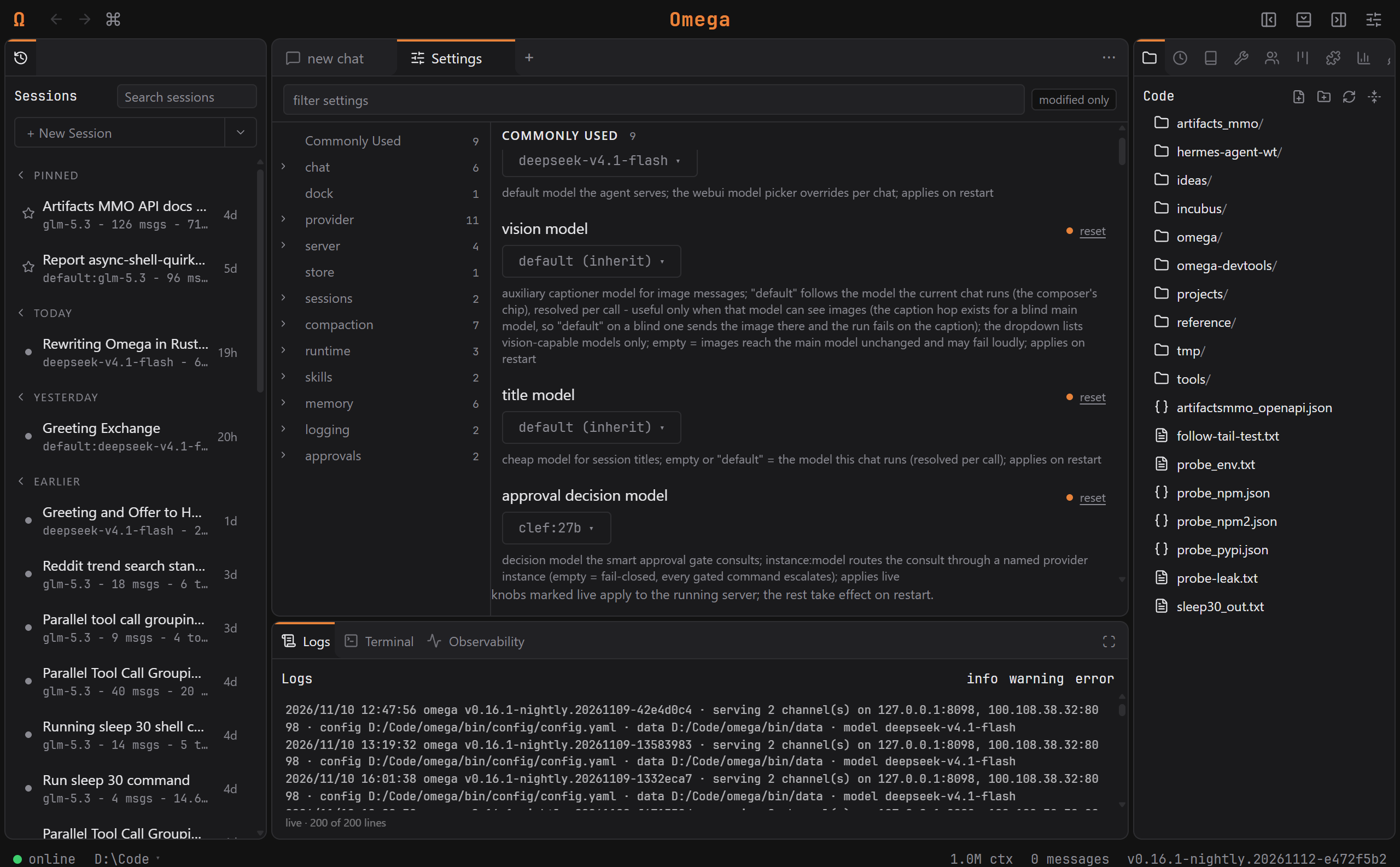
omega today: settings as one document
State of the project: v0.17 turns settings into one searchable document, the agents tab gets a real chat, and the fleet that builds omega is the part worth watching.
Endo
omega shipped 0.17 this week. The changelog undersells it, so here is where the project actually is. Two things: the settings tab stopped being a settings tab, and the way this thing gets built has quietly become the most interesting part.
First the boring-sounding one.
Settings in agent tools are usually a pile of dialogs. omega had the same disease. Toggles scattered across panes, knobs that lived in three places, no honest answer to "what did I change".
0.17 rebuilds all of it as one document. A search bar that actually filters. Commonly used knobs first, everything else in one scrollable list, grouped by what they do. A dot marks what you changed from default. One click puts it back. Same shape VS Code settled on years ago. That shape won for a reason.
The agents tab got the same treatment. Every agent now has a real chat bound to its latest session, so you talk to the agent you configure, not to a roster row. And agent settings render as per-agent scopes: a Main | agents strip, and each agent tab shows only the things an agent can override - provider, model, system prompt, max turns. Nothing else. The config layering law is the same one the binary boots on.
Now the part I actually want to talk about.
I do not write omega's code. An agent fleet does. One main agent plans the work with me. Worker agents implement it, one card at a time. A reviewer agent gates every card before it merges - no card lands unreviewed. And every night a test suite drives a real browser through the web UI like a user would: dock a pane, send a chat, break the socket, watch it reconnect.
The receipts: 1,808 Go tests, 1,759 web UI tests, both green on the release tip. The settings rebuild above went through that pipeline as six cards in one day.
Here is why you might not care. This pipeline took real law to build. Agent workers will happily merge their own work if a card body has a gap, so every rule they must follow lives in the repo, not in vibes. The docs drifted too - a recent audit found nine claims that were flat false against the actual code. All nine were written by agents. All nine got fixed by one card. Agent-built software still needs someone who owns the merge. That is me. Every commit to master, every tag, every release is my call, and it stays that way.
The models ride Ollama Cloud endpoints. The product is local-first - one binary, loopback by default, your hardware - but I am not going to imply the build farm runs on a potato. It runs on a Pi, a Windows box and a cloud bill.
- The socket reconnect that never happened: close events were going unnoticed and a dead socket stayed dead. The browser journeys caught it, a measured fix landed, the journey now goes green.
- The docs got a truth pass: every claim was checked against the tree, not against memory.
- The composer lost its workdir selector - it lives in the status bar now, where it always belonged.
The next window is the context arc. We measured a real inefficiency in how the prompt gets assembled - the tool schemas were reshuffling every single turn, which quietly wrecks prompt caching - and the fix is already through review. Compaction and context selection follow.
One binary, settings that read like a document, and a fleet that ships when the tests say so. 0.17 is on GitHub now. The roadmap is public.